
On paper, content creation should be easier than ever.
AI can generate outlines, drafts, summaries, and variations in minutes. Tools promise faster turnaround, lower costs and infinite scalability. From the outside, it looks like the messy parts of content production have been solved.
In reality, most agencies are still dealing with bottlenecks. They just don’t happen where they used to.
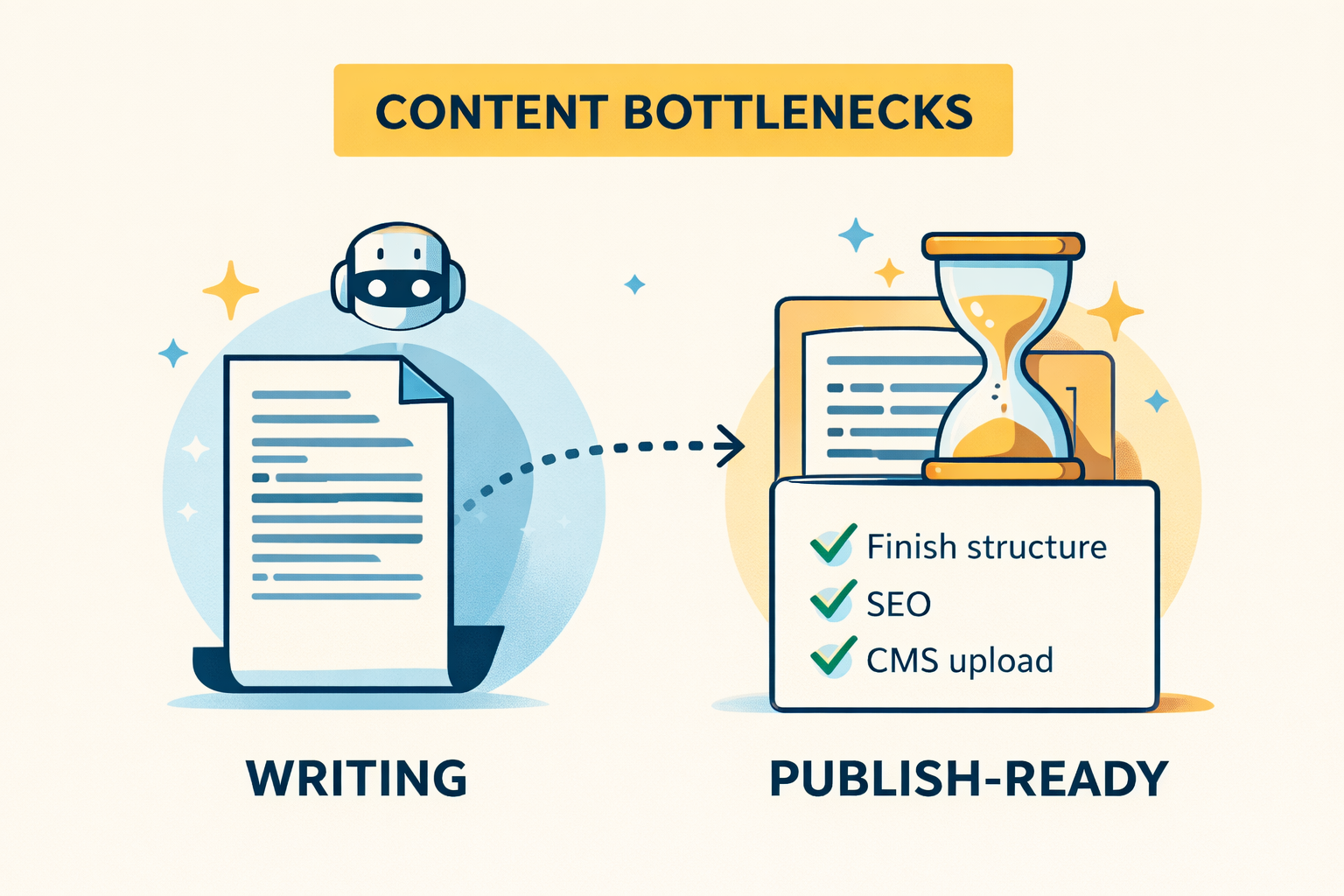
The problem isn’t writing anymore. It’s everything that comes after.
The Old Bottleneck: Starting From Scratch
Not that long ago, the slowest part of content production was the blank page.
An agency would brief a writer, wait for a draft, request revisions, and then pass it on to someone else for SEO checks, formatting, and upload. Writing was the main constraint, and most timelines revolved around it.
AI has largely removed that initial friction.
Drafts appear quickly. Variations are easy to generate. Ideas are no longer scarce. If all you need is “something written,” that part is rarely the issue now.
But content doesn’t stop being work just because a draft exists.
The New Bottleneck: Turning Drafts Into Finished Content
What I see far more often today is content piling up in half-finished states.
There are documents full of AI-generated drafts that look complete at a glance but haven’t been properly shaped. There are blog posts that technically exist but haven’t been fact-checked. Pages that have keywords inserted but no real structure. Articles that haven’t been uploaded because no one has time to format them properly.
This is where most delays now happen.
AI gets you to “something,” but agencies still need to get from “something” to “publish-ready.”
That final stretch involves a lot of unglamorous but essential work:
- Fixing structure so the page actually flows
- Deciding what to expand, cut, or move
- Checking tone against brand guidelines
- Adding internal and external links sensibly
- Making sure keywords aren’t overused or awkward
- Formatting content correctly in WordPress
- Sourcing or recommending suitable images
- Reviewing everything once it’s live
None of this is difficult in isolation. But it’s time-consuming, and it requires attention.
Why This Work Often Gets Deprioritised
One reason this stage becomes a bottleneck is that it doesn’t feel like “creative” work.
Agencies are under pressure to produce volume. Drafts feel like progress. Publishing feels like admin. When deadlines pile up, it’s tempting to move on to the next task and assume the finishing touches will happen later.
Often, “later” doesn’t come.
The result is content that exists but doesn’t perform. Pages that rank poorly, read awkwardly, or quietly undermine a client’s credibility. From the outside, it looks like the agency is producing plenty of content. From the inside, everyone knows it’s not quite where it should be.
Editing Is No Longer a Light Touch
Another shift I’ve noticed is how editing itself has changed.
Editing used to mean polishing language and correcting grammar. With AI-assisted drafts, editing is closer to reconstruction. It’s about interrogating the content rather than tweaking it.
Questions come up constantly:
- Is this actually answering the search intent?
- Are the examples specific enough to be believable?
- Does this section add value or just repeat what’s already been said?
- Is the confidence level appropriate, or does it sound generic?
- Would a real reader trust this?
AI doesn’t reliably answer those questions. Someone has to.
That’s why editing now takes more judgment than it used to, even if the words arrive faster.
Finished Content Is the Real Deliverable
One of the biggest mindset changes agencies are making is redefining what “done” looks like.
A Google Doc isn’t done. A draft isn’t done. Even a well-written article isn’t done if it’s not correctly uploaded, structured, and ready to be published without further intervention.
Finished content is content that:
- Is accurate and coherent
- Fits the brand and audience
- Is optimised without being forced
- Is formatted correctly in the CMS
- Has links, images, and structure in place
- Can go live immediately
That’s the point where content becomes useful.
More and more agencies are realising that this final stage is where they need the most support – not because it’s flashy, but because it’s where things tend to stall.
AI Didn’t Replace the Work – It Rearranged It
AI hasn’t removed effort from content production. It’s redistributed it.
Less time is spent drafting from scratch. More time is needed to review, shape, validate, and finish. The skills that matter most now aren’t speed typing or word count, but judgment, organisation, and an understanding of what quality actually looks like.
For agencies managing multiple clients and deadlines, that shift matters. Content that moves smoothly from idea to published page creates momentum. Content that gets stuck in draft form quietly drains time and attention.
From where I sit, that’s the real change AI has brought.
Not fewer tasks – just different ones.