
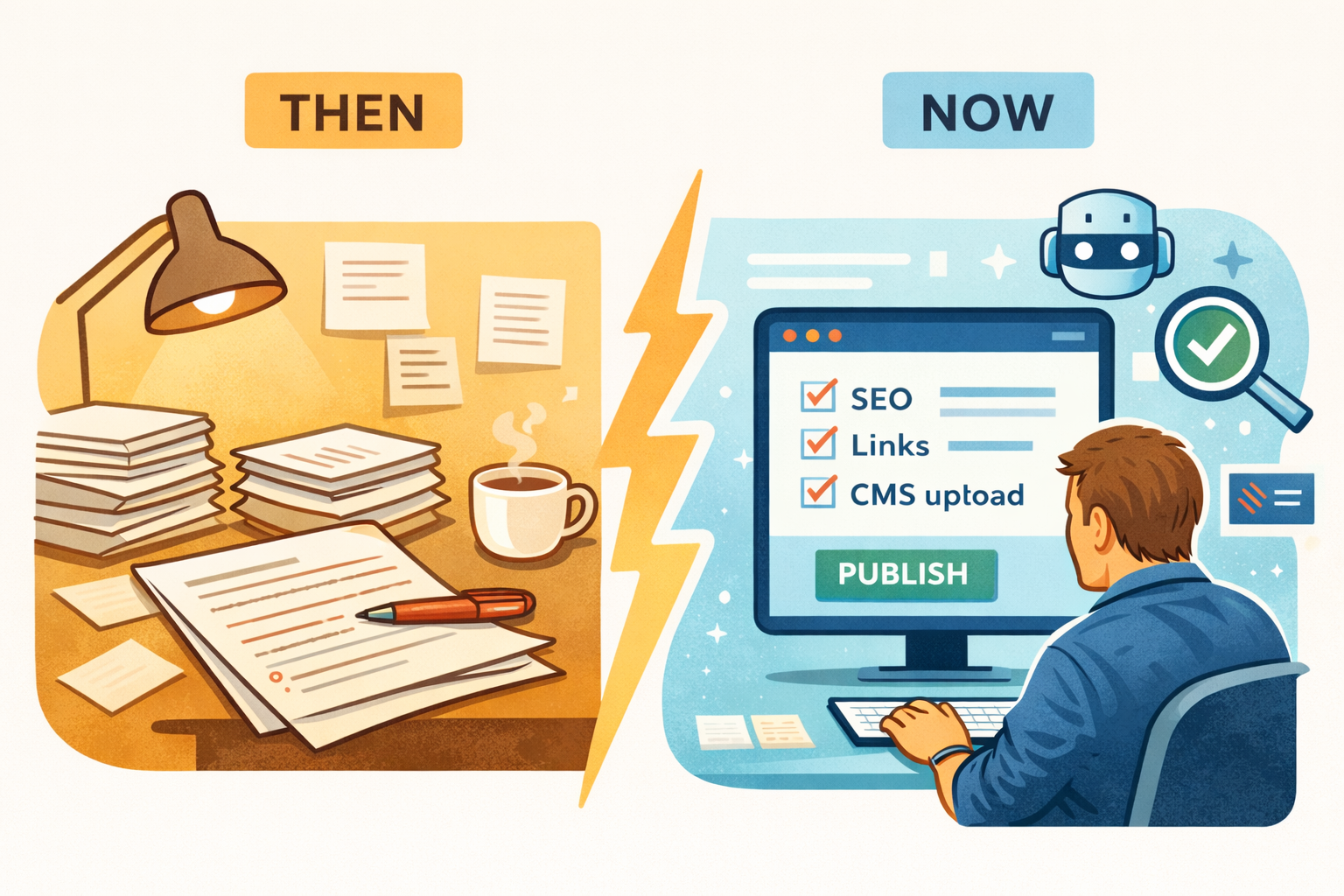
A few years ago, almost all of my agency work was straightforward content writing.
Brief in, article out. That was the job.
An agency would send over a topic, maybe a few bullet points, and I’d write a blog post, landing page, or article from scratch. Once it was delivered, it moved on to the next stage of the agency’s process and my involvement largely ended there.
That model still exists, but it’s no longer the default.
Today, agency content work looks very different.
From Writing to Shaping
These days, I’m just as likely to spend my time:
- Editing and reshaping AI-generated drafts
- Improving structure and flow
- Checking facts and tone
- Adding internal links and keywords
- Uploading and organising content in a CMS
Writing still matters, but it’s no longer the whole role.
AI has changed how content is produced, and there’s no denying the impact it’s had on speed and volume. Ideas that once took hours to draft can now appear in minutes. Outlines, summaries, and first drafts are easier than ever to generate.
But while AI has accelerated the early stages of content creation, it hasn’t removed the need for judgment. If anything, it’s made that judgment more important.
The Gap Between “Generated” and “Good”
One of the biggest changes I’ve noticed is the widening gap between content that technically exists and content that’s actually ready to publish.
AI can produce something that looks like a finished article at a glance. The headings are there. The paragraphs are coherent. The grammar is fine. But once you read more closely, issues start to surface.
The structure might be slightly off. Important points are buried halfway down the page. The tone might drift between confident and vague. Facts are sometimes correct but poorly framed, or confidently wrong. Examples feel generic. Sentences repeat the same ideas using different wording.
None of these issues are catastrophic on their own. But together, they create content that feels flat and unconvincing.
That’s where the work has shifted.
A large part of my role now is taking those rough drafts and turning them into something that makes sense, sounds human, and actually reflects well on the agency and its client.
Judgment Is the Real Skill
What AI can’t do particularly well is decide what matters.
It doesn’t know which sections deserve more space and which can be cut entirely. It doesn’t understand a client’s brand voice beyond surface-level patterns. It doesn’t recognise when something sounds technically fine but emotionally off.
Those decisions still require experience.
Editing AI-assisted content isn’t about polishing grammar or swapping out a few phrases. It’s about asking basic but important questions:
- What is this page actually trying to achieve?
- Is this the right level of detail for the audience?
- Does this flow logically from one point to the next?
- Would a real reader find this useful, or just inoffensive?
Answering those questions is where most of the value now sits.
Content Is No Longer “Done” When It’s Written
Another noticeable shift is how much more end-to-end content work has become.
In the past, writing and publishing were often handled by different people. Today, agencies are under pressure to move quickly and reduce friction. That means fewer handoffs and more emphasis on content that’s genuinely finished.
Increasingly, that includes:
- Adding internal and external links
- Making sure keywords are used sensibly rather than mechanically
- Sourcing or recommending appropriate images
- Formatting content correctly in WordPress or another CMS
- Checking how everything looks once it’s live
From an agency perspective, this makes complete sense. Content that sits half-finished in a document isn’t especially useful. Content that’s uploaded, organised, and ready to publish is.
As a result, the role has expanded beyond “writer” into something closer to content operator or quality controller.
What Hasn’t Changed
Despite all of this, some things haven’t changed at all.
Good content still needs clarity. It still needs intent. It still needs to respect the reader’s time. And it still reflects directly on the business or agency behind it.
AI hasn’t changed those fundamentals. It’s simply changed how drafts are created and where effort is best spent.
The agencies I work with aren’t looking for someone to compete with AI. They’re looking for someone who understands how to use it sensibly – and, just as importantly, when not to rely on it.
Watching the Role Evolve
From the inside, it’s been interesting to watch the role of writers quietly evolve.
The work is less about producing words from nothing and more about shaping, refining, checking, and finishing. Less about output for its own sake, and more about responsibility for what actually goes live.
AI has made content creation faster. It hasn’t made it finished.
And for agencies juggling multiple clients, deadlines, and expectations, that final stretch – from rough draft to publish-ready content – is where experience still matters most.